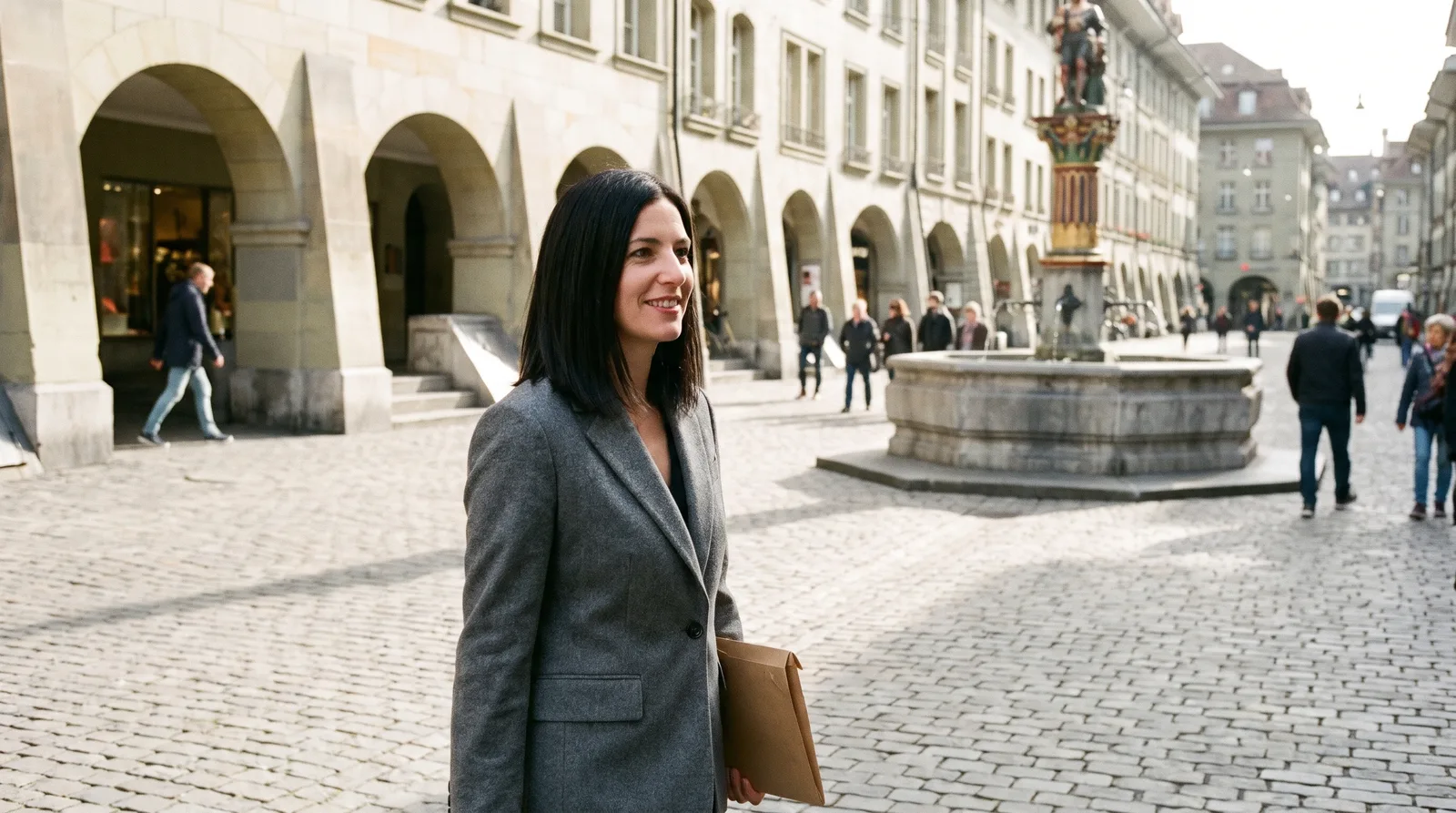
To apply for a job in Zurich, Basel or Bern, you send a "Bewerbungsdossier", a complete file combined into a single PDF: cover letter (Motivationsschreiben), CV (Lebenslauf), work certificates (Arbeitszeugnisse) and diplomas. The file is written in standard German, not dialect, using Swiss spelling with "ss" instead of "ß". Most jobs require professional German.
You live in Geneva, in Lausanne or just across the border in France, and a job in Zurich, Basel or Bern has caught your eye. The salary, the role, the company: everything fits. What remains is knowing how to apply on the other side of the Sarine, the river that symbolises the language border, in German-speaking Switzerland, where the conventions are not quite those of the French-speaking part.
The good news: the logic is the same as for a Swiss CV in French-speaking Switzerland. The bad news: the details change, and they are what give away a candidate who has not done their homework. This guide goes through what really differs, document by document. If your question is rather where to work without German, we covered it in finding a job in Switzerland without speaking German.
Do you really need to speak German to work in Zurich, Basel or Bern?
Yes, for the vast majority of jobs in Zurich, Basel or Bern, professional German is expected. According to the Swiss Federal Statistical Office (FSO), 62% of Switzerland's permanent resident population named German or Swiss German in 2020 as their main language, or one of their main languages. Jobs entirely in English remain a minority.
English is gaining ground, especially in the big cities. According to the FSO publication "Languages at work" (page in French), published on 18 June 2026, the share of employed people who usually speak English at work rose from 19% to 24% in ten years (2024 data). In Basel, around the pharma industry, or in Zurich, in finance and tech, entire teams work in English.
But let us be honest: these jobs are a minority, and highly contested. For the vast majority of roles, German is expected, and not only for the work itself. Informal meetings, exchanges with clients, the lunch break all happen in German or in dialect.
The right reflex is to read the job ad:
| What the ad says | Language of your application |
|---|---|
| Written in English, "German is a plus" | English |
| Written in German, "sehr gute Deutschkenntnisse" | German, at a solid level |
| Written in French, or the company is clearly bilingual | French is possible |
Standard German or Swiss German: which one do you need?
A candidate applying in German-speaking Switzerland needs standard German, called Hochdeutsch, or "Schriftdeutsch" in Switzerland. Standard German is the written language and the language of the application file. Swiss German (Schweizerdeutsch) refers to the dialects spoken day to day. Recruiters do not expect a French-speaking candidate to speak dialect.
In German-speaking Switzerland, there are therefore two realities:
- Standard German is the language of letters, contracts, reports and job ads. It is the language of your file.
- Swiss German varies from one region to another and is not written in a formal professional context.
You will pick up dialect little by little once you are there. Listing it as a skill is a real plus, but only if it is true.
What goes into an application file in German-speaking Switzerland?
An application file in German-speaking Switzerland, the "Bewerbungsdossier", contains a cover letter, a CV, work certificates from previous employers, the diplomas relevant to the job and often a note on references. The documents are combined into a single PDF, in this order. The Bewerbungsdossier resembles the French-speaking Swiss file, only more systematic.
| Document | Name in German | What is expected |
|---|---|---|
| Cover letter | Motivationsschreiben or Anschreiben | One page, focused on the job |
| CV | Lebenslauf | One to two pages, reverse chronological, often with a photo |
| Work certificates | Arbeitszeugnisse | From your previous employers, especially the most recent |
| Diplomas | Diplome, Zertifikate | Copies of the qualifications relevant to the job |
| References | Referenzen | Often a line "auf Anfrage" (on request), sometimes listed |
Name the file properly, for example "Bewerbung_Name_Firstname.pdf". On large companies' application platforms, you upload the documents separately, but the order stays the same.
How do you adapt your CV to Swiss style for Basel or Zurich?
A CV for Basel or Zurich, the "Lebenslauf", follows the structure of the French-speaking Swiss CV: one to two pages, reverse chronological order, personal details in the header and often a photo. The differences lie in the section names, Swiss spelling without "ß" and the precision expected on your German level, stated with the European scale.
The sections. Persönliche Angaben (personal details), Berufserfahrung (experience), Ausbildung (education), Weiterbildung (further training), Sprachkenntnisse (languages), IT-Kenntnisse (IT skills), Referenzen.
Personal details. As in French-speaking Switzerland, people often state their date of birth, nationality and permit: "Aufenthaltsbewilligung B" (the B permit, a residence permit) or "Grenzgängerbewilligung G" (the G permit, the work authorisation for cross-border commuters). These details are not mandatory, but leaving them out can make a recruiter hesitate about your right to work.
The photo. A photo is common on a Swiss Lebenslauf. It is not required, but if you include one, it must be professional. We cover this in detail in our article on the photo on a CV in Switzerland.
Languages. State your level using the Common European Framework of Reference for Languages (from A1 to C2), and be precise: "Deutsch: B2 (Goethe-Zertifikat)" is better than "gute Kenntnisse". Overstating your German is the most costly trap, because the interview will be held in that language. For the method, see how to state your language level on a CV.
Swiss spelling. The German spelling guide of the Swiss Federal Chancellery (copy published by the canton of Zug) points out that the letter "ß" has not been written in Switzerland since the 1970s. You write "Strasse", "Grüsse", "gross". A CV full of "ß" shows you reused a German template without adapting it.
How do you write a German cover letter for Switzerland?
A German cover letter for Switzerland, the "Motivationsschreiben", fits on one page and answers the same questions as in French: why this job, why this company, what the candidate brings. The tone is more sober and factual than in French-speaking Switzerland. The salutation includes the recipient's name, and the closing formula stays short.
A few conventions to follow:
- The salutation with the name: "Sehr geehrte Frau Meier," or "Sehr geehrter Herr Keller,". If you do not know the name, "Sehr geehrte Damen und Herren,".
- Lower case after the comma of the salutation. The first sentence starts in lower case, unless the first word is a noun or the polite "Sie".
- A short closing: "Freundliche Grüsse", with your name below. The long French-style closing formulas do not exist in German.
- The formal "Sie", always, even if the company uses the informal "du" on its website.
A common mistake is translating a French letter word for word. The result sounds wrong, with sentences that are too long and phrases that do not exist in German. A shorter letter written directly in German and proofread by a native speaker is better.
What should you do with work certificates when applying in German?
Work certificates belong in the file, even in French. Under Article 330a of the Code of Obligations (CO), the code that contains Swiss employment contract law, the employer must provide on request a certificate covering the nature and duration of the job, the quality of the work and conduct. In German, this document is called an Arbeitszeugnis.
The State of Geneva explains this right to a work certificate (page in French). Recruiters in German-speaking Switzerland read certificates carefully, even between the lines. Certificates are written in a coded language, the "Zeugnissprache", where apparently positive phrases can qualify an assessment.
A certificate in French can be attached as it is. Most Swiss recruiters will understand it, and a translation is only really needed for a company with no link at all to French-speaking Switzerland. To learn how to read and demand a good certificate, see our article on the Swiss work certificate.
If you come from France, you will not have a work certificate in the Swiss sense. Attach your employer statements or letters of recommendation, and mention references who can be reached.
Where can you find jobs in German-speaking Switzerland, and how do you stand out?
Job offers in German-speaking Switzerland appear on national job boards such as jobs.ch, on the career sites of companies and cantons, and through the public employment service. The regional employment office (ORP in French), the Swiss public job agency and counterpart of France Travail, is called the RAV (Regionales Arbeitsvermittlungszentrum) in German-speaking Switzerland.
The official portal arbeit.swiss, the site of Swiss unemployment insurance and the public employment service, presents the RAVs and their services. The career sites of large companies and cantons also publish jobs you will not find elsewhere.
To stand out when applying from French-speaking Switzerland or France:
- Show that you have thought about the commute. One line in the letter is enough: you plan to move, or you have worked out the journey. The recruiter is wondering about it, so answer before they ask.
- Highlight your bilingualism. French is a sought-after skill in German-speaking Switzerland, especially in companies that serve the whole country. It is an argument, not a handicap.
- Really adapt each file. The keywords of the posting must appear in your Lebenslauf, in German. A CV in French sent as is for a posting in German starts at a clear disadvantage.
This is where candidat.app saves you time: starting from your real background, the tool generates a CV and a letter for each posting, adapted to the ad, to Swiss conventions and to the language of the offer, without inventing anything about your profile. You keep control of every word, and you get whatever needs it proofread.
In summary
Applying in German-speaking Switzerland means sending a complete Bewerbungsdossier: Motivationsschreiben, Lebenslauf, Arbeitszeugnisse and diplomas, in a single PDF. The file is written in standard German, with Swiss spelling and no "ß". The level of German expected depends on the job: English is enough in some international teams in Zurich or Basel, but most jobs require professional German. State your level honestly using the European scale, attach your work certificates, anticipate the commuting question, and make your French an asset.
FAQ
Can you apply in French in German-speaking Switzerland?
An application in French is possible if the job ad is written in French or if the company is clearly bilingual. Otherwise, the rule is to apply in the language of the ad: in German if it is in German, in English if it is in English.
Do you need to speak Swiss German to be hired in Zurich or Basel?
Generally not. Recruiters expect good standard German. Swiss German is a plus, often learned on site, but it is rarely required of a French-speaking candidate.
What German level should you put on your CV for German-speaking Switzerland?
Your real level, on the European scale from A1 to C2, ideally backed by a certificate such as the Goethe-Zertifikat. An overstated level shows as soon as the interview starts, since it is held in German.
Should you translate your work certificates into German?
Not necessarily. A work certificate in French is understood by most Swiss recruiters. For a company with no link to French-speaking Switzerland, a translation can help, but it is not a general requirement.
Why avoid the "ß" in a Swiss application?
Swiss spelling has not used the letter "ß" since the 1970s, according to the Federal Chancellery's guide. You write "Strasse" and "Freundliche Grüsse". A "ß" reveals a German template copied without adaptation.
