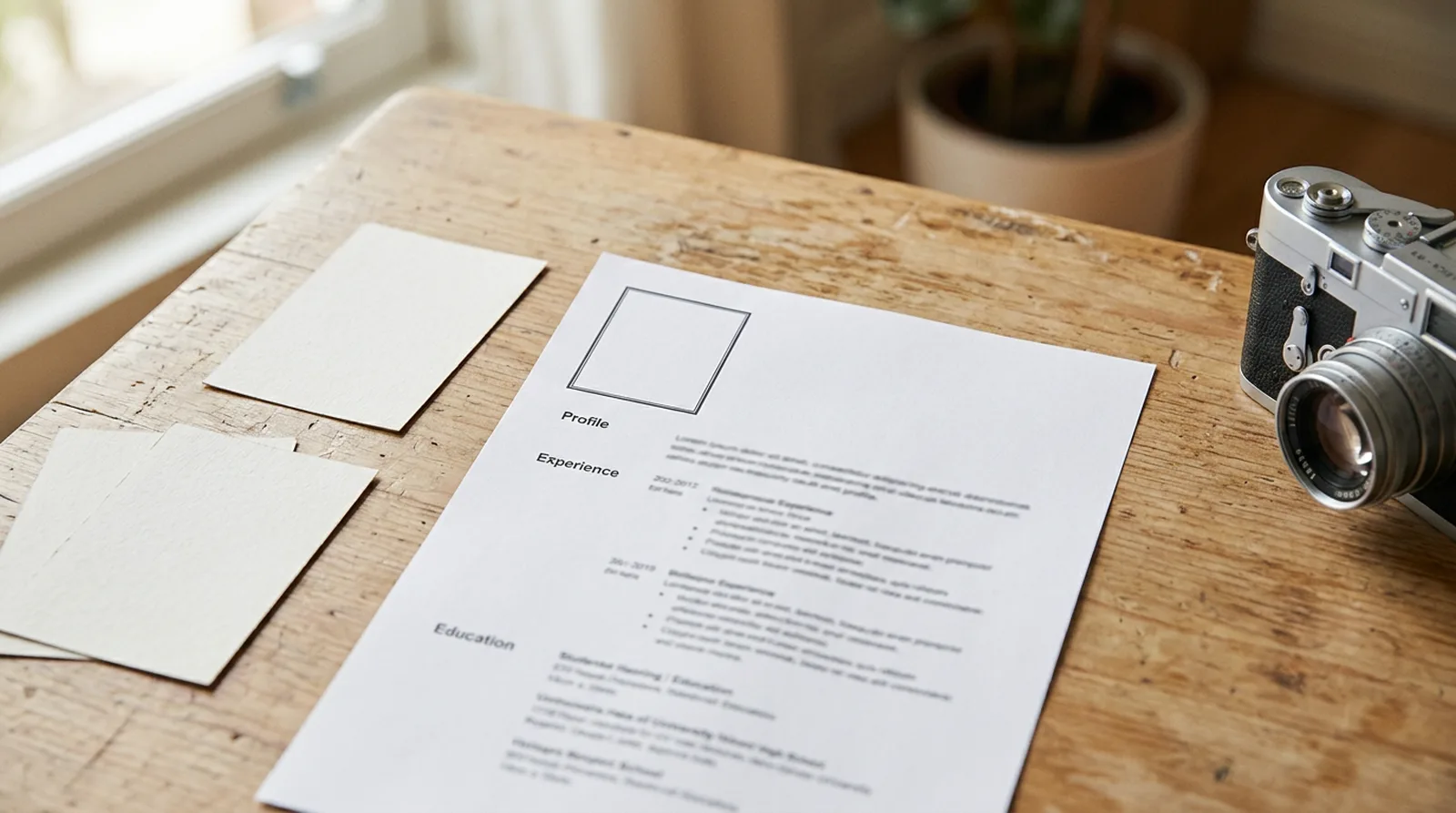
In Switzerland, a photo on your CV is not legally required, but it is strongly expected. It appears on almost every Swiss CV, and its absence can raise eyebrows, especially in traditional sectors such as banking, insurance, law and hospitality. Unless the employer says otherwise, or you are applying to a large international organisation, include a photo. It must be professional, recent and understated: a poorly chosen photo does more harm than no photo at all.
"Should I include a photo or not?" "Will a Swiss recruiter be put off if I leave it out?" When you prepare an application for Switzerland, often from abroad or as a cross-border commuter, this question comes up almost every time. And that is understandable: the conventions are not the same as elsewhere.
In this article, we settle the question of the photo on a Swiss CV once and for all: what recruiters really expect, the differences between French-speaking and German-speaking Switzerland, the cases where you can skip it, and above all how to get a photo that works in your favour rather than against you.
Is a photo mandatory on a Swiss CV?
No, no law requires a photo on a CV in Switzerland. It is neither an obligation nor a ban. But in practice it is a firmly established norm: almost every CV Swiss recruiters receive includes a photo. In other words, if you leave it out, your application stands apart from the norm, and that can get noticed.
The photo is part of Swiss application culture, in the same way as the reverse-chronological career history or the restraint of the layout. A recruiter used to seeing a face on every CV may wonder about an application with no photo: an oversight, reluctance, or a deliberate choice? That is a needless doubt, and there is no reason to create it.
The default rule is therefore simple: include a photo, unless the posting explicitly asks you not to, or you are applying in an international context where it is discouraged (more on that below).
What do Swiss recruiters actually look at?
A photo on a Swiss CV is not a decorative formality. Consciously or not, the recruiter reads several signals in it: your seriousness, your ability to follow the conventions, and the professional image you project. A polished photo reinforces the first impression; a careless one sabotages it.
Three things matter more than the mere presence of the photo:
- Professionalism. A photo taken in a professional setting, on a neutral background, in tidy attire, sends the right signal. A selfie, a cropped holiday snapshot or an image with a filter does the opposite.
- Alignment with the role. In client-facing jobs (customer relations, communication, reception, hospitality), the photo is almost unavoidable. In some technical or R&D roles it carries less weight, but it is still expected.
- The readability of your application. Many Swiss companies screen CVs with software before any human looks at them. To these tools, the photo carries no weight at all: it never replaces structured content and relevant keywords. To understand this filtering, read our article on how the ATS works.
In short, the photo supports your application but does not carry it. It rounds out a strong CV; it never makes up for a weak one.
French-speaking or German-speaking Switzerland: is there a difference?
Yes, expectations vary by region, even though the photo remains common everywhere. A Swissstaffing survey cited by Swiss HR guides shows that 58% of employers in French-speaking Switzerland consider the photo welcome, compared with 37% in German-speaking Switzerland. The photo is therefore especially valued on the French-speaking side, particularly in smaller organisations and in roles where personal contact is central.
In Geneva and within large international organisations, the logic sometimes flips: some follow the Anglo-Saxon standard, where a CV without a photo is the norm in order to avoid any hiring bias. There, a CV with no photo passes without a problem, and may even be preferred.
| Context | Photo expected? | Key takeaway |
|---|---|---|
| French-speaking Switzerland, SMEs, client-facing roles | Yes, strongly | The photo is welcome and reassuring |
| Banking, insurance, law, hospitality | Yes | Traditional sectors, the photo is the norm |
| Standard large Swiss company | Yes, by default | Including one remains the safe choice |
| International organisation, NGO, Geneva | Optional | Anglo-Saxon standard, no photo accepted |
| The posting asks you not to include one | No | Always follow the employer's instruction |
When in doubt, look at the posting and the company. A multinational with an Anglo-Saxon head office? You can skip it. A standard employer in French-speaking Switzerland? Include a photo.
Can you apply without a photo to avoid discrimination?
It is a legitimate argument. A photo reveals age, gender, sometimes origin, all of which can feed hiring bias. The anonymous CV, which hides name, age, nationality and photo, is in fact recommended by the Federal Commission against Racism to fight unequal treatment. According to the OECD, anonymous applications increase the chances of landing an interview for ethnic minorities.
But in Switzerland, this practice remains marginal. Swisscom trialled the anonymous CV as early as spring 2015, with results judged very modest. The anonymous CV is not something you decide on your side: it is the employer who puts the scheme in place. Removing your photo unilaterally from a standard application is not enough to protect you from bias, since your name, age and career history stay visible, and above all it makes you stand apart from the local norm.
The right stance is therefore pragmatic: follow the scheme when the company offers one, and in every other case, play by the Swiss conventions with a professional photo.
How do you get your Swiss CV photo right?
A bad photo hurts more than no photo. Here are the criteria Swiss job platforms such as jobup.ch look for in a photo that inspires confidence.
| Criterion | Best practice | What to avoid |
|---|---|---|
| Setting | Professional photo, sharp portrait | Selfie, cropped group photo |
| Background | Neutral and plain (white, light grey, very pale blue) | Coloured background, holiday scenery |
| Freshness | Less than 2 years old, current likeness | A photo from ten years ago |
| Format | ID-style portrait, roughly 35 x 45 mm | Blurry or stretched image |
| Attire and attitude | Tidy attire, natural smile | Sunglasses, hat, filters |
| Lighting | Even light, face clearly visible | Backlighting, harsh shadows |
The habit that changes everything: invest once in a professional photo and reuse it on both your CV and LinkedIn, for a consistent image. A session with a photographer costs little compared with its effect on your first impression.
Once the photo is ready, you still need to place it cleanly, without breaking the layout or hindering how screening software reads it. That is where candidat.app comes in: the tool generates a CV calibrated to Swiss conventions, with a clean photo placement and a structure that is readable by a recruiter and an ATS alike, based on your real background. To go further on layout, see also our guide to the Swiss CV format.
In short
In Switzerland, a photo on your CV is not mandatory but strongly expected: almost every application includes one. By default, include a photo, unless the employer says otherwise or you are applying to a large international, Anglo-Saxon-style organisation. The photo is especially valued in French-speaking Switzerland and in traditional sectors. Above all, take care with it: neutral background, professional attire, natural smile, less than two years old. A careless photo hurts more than no photo. It supports a solid application; it never replaces one.
FAQ
Is a CV without a photo automatically rejected in Switzerland?
No, no rule automatically discards a CV without a photo. But since the vast majority of applications include one, its absence can surprise the recruiter, especially in French-speaking Switzerland and in traditional sectors. When in doubt, it is better to include one.
What size and format should the photo be?
A portrait format close to an ID photo, roughly 35 x 45 mm, on a neutral, plain background. What matters is that your face is sharp, well lit and easily identifiable.
Can I reuse my LinkedIn photo?
Yes, if it is professional, recent and understated. A consistent photo across your CV and your LinkedIn profile even strengthens your image. Avoid a photo that is too casual or dated, however.
Do I need a photo to apply to an international company in Geneva?
Not necessarily. Many international organisations follow the Anglo-Saxon standard where a CV without a photo is the norm. Look at the posting and the company culture: in that context, leaving out the photo is no problem.
Is a bad photo worse than no photo?
Yes. A selfie, a cropped holiday snapshot or an image with a filter signals a lack of seriousness. If you do not have a good photo, it is better to get a decent one taken than to include a careless one.