
A Swiss application file contains a cover letter, a CV, work certificates from previous employers and copies of diplomas. Foreign applicants add their residence permit. The file is usually sent as a single PDF, in this order: letter, CV, certificates from most recent to oldest, diplomas. References are given on request.
If you come from France, Belgium or elsewhere, the word "file" can be surprising. Elsewhere, you send a CV and a cover letter, and that is it. In Switzerland, many job ads ask for a "complete file", and those two words refer to a precise list of documents that recruiters expect to find.
This guide covers the documents, the order to put them in and the mistakes that make a bad impression before anyone reads your background. It does not cover the steps of the hiring process (interviews, tests, offer), only what you send.
What does a Swiss application file contain?
A complete Swiss application file brings together four core documents: the CV, the cover letter, work certificates and copies of diplomas. Depending on the applicant's situation, a copy of the residence permit and a criminal record extract are added. The list of references usually comes later, when the employer asks for it.
The core is the same almost everywhere, from a small shop to a large hospital. Here are the documents, in order of real importance.
| Document | Required? | What it gives the recruiter |
|---|---|---|
| CV | Yes | The document that decides. Background, skills, languages, permit |
| Cover letter | Almost always requested | The link between your profile and this specific job |
| Work certificates | Expected if you have worked in Switzerland | A written assessment from your former employers |
| Copies of diplomas | Expected for qualified roles | Proof of your training |
| Copy of residence permit | Useful if you are not Swiss | Removes any doubt about your right to work |
| Criminal record extract | Only if the ad asks for it | Required in some fields (security, finance, childcare) |
| List of references | Rarely in the first submission | Contacts to call, with your consent |
Let us be honest about the hierarchy. The CV decides, the letter tips the balance. A recruiter who receives many files opens the CV first. If the profile fits, they read the letter, then flick through the certificates to confirm what they have just seen. Diplomas mainly serve as verification.
The Swiss CV has its own conventions: a photo is common but not mandatory, nationality and permit are often stated, one to two pages. Our guide to the Swiss CV format covers them in detail.
Why do work certificates matter so much in Switzerland?
A work certificate is a written document signed by the employer, describing the job, its duration, the quality of the work and the employee's conduct. In Switzerland, any employee can demand one at any time, under article 330a of the Code of Obligations. Swiss recruiters therefore read these certificates as proof of the background stated in the CV.
The Canton of Geneva points out in its staff guide that this right to a certificate is absolute. Every job in Switzerland therefore leaves a written record. A file with no certificates, when the CV lists five years of Swiss experience, raises a question. The applicant is not rejected for that, but the recruiter will wonder why.
Three situations are possible:
- You have worked in Switzerland. Attach all your certificates, from most recent to oldest. If one is missing, ask your former employer for it, they are required to provide it.
- You come from a country without this practice. Nobody expects a French or Belgian certificate. You can attach a reference letter or a proof of employment if you have one, nothing mandatory.
- You are still in your job. The interim certificate, issued during the contract, is provided for by law. Choose the moment you ask for it carefully, because the request often signals that you are looking elsewhere.
The difference between a full certificate and a simple attestation, and how to read the coded wording, are explained in our article on the Swiss work certificate.
In what order should you assemble a Swiss application file?
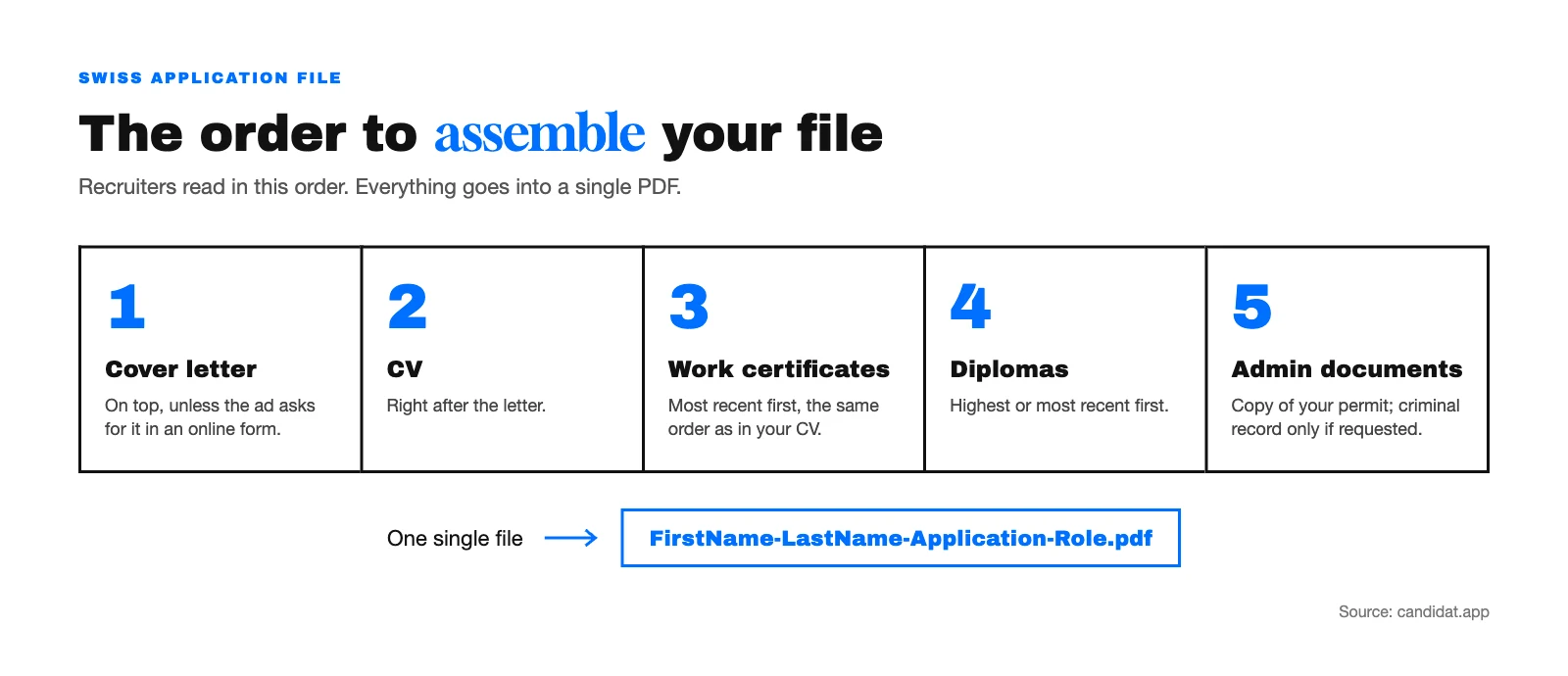
A Swiss application file is assembled from the document that introduces to the documents that prove: cover letter, CV, work certificates from most recent to oldest, diplomas, then administrative documents. This order lets the recruiter find the document they are looking for in a few seconds, without searching through a messy file.
- Cover letter on the first page, unless the ad asks you to paste it into an online form.
- CV, right after.
- Work certificates, from most recent to oldest, the same order as in your CV.
- Diplomas and training certificates, from the highest or most recent to the oldest.
- Administrative documents: copy of the permit, criminal record extract if requested.
Some applicants add a cover page or a table of contents. It is not a mistake, but for a ten-page file it adds little. The most useful thing is still a clearly named file.
Should you send your application file as a single PDF?
For an application sent by email, a single well-named PDF is the most practical format for a Swiss recruiter: they open it, forward it to the head of department and print it in one go. On an online recruitment portal with one field per document, the applicant instead follows the requested split, document by document.
Five attachments named "scan001.pdf" to "scan005.pdf" force the recruiter to open each file to understand what it contains. On a portal, the software files each document in its place and the recruiter finds it under the right tab.
| Point | Good habit |
|---|---|
| Format | PDF throughout, never photos of documents taken with a phone |
| File name | FirstName-LastName-Application-Role.pdf |
| Size | A light file opens anywhere. Scan certificates and diplomas in black and white if your file gets heavy |
| Legibility | Straight, sharp scans, with no finger shadow on the edge |
| CV | Exported from a word processor, not scanned, so that screening software can read it |
The last point matters. Many companies run applications through screening software that reads and files the CV before a human opens it. A scanned CV becomes an image that the software cannot read. Our comparison CV in PDF or Word explains how to produce a clean file.
Should you include references, your permit and your diplomas in the file?
Diplomas are always attached, as copies, for a qualified role. The permit is stated on the CV, and a copy saves a question. References, on the other hand, are almost never attached to the first submission: "References available on request" is enough, and the employer must obtain your consent before contacting a former employer.
References. A short list of two or three people, with their role and phone number, is still possible if you prefer. According to the Federal Data Protection and Information Commissioner, the Swiss data protection authority, the employer must obtain your prior consent before contacting your current employer or a former one. Let your referees know, they will appreciate not being caught off guard. Our article on references on a CV shows how to present this section.
The permit. If you are not Swiss, state your status on your CV: B, C, G or L permit. These are the Swiss residence and work permits, the G permit being the one for cross-border commuters who live outside Switzerland. If you are a citizen of a European Union country, write "EU national, permit to be obtained": according to the State Secretariat for Migration (SEM), the Swiss federal immigration office, an employment contract of at least one year gives the right to a B permit. Our guide to Swiss work permits helps you work out which one applies to you.
The criminal record extract. Only send it if requested, usually for jobs in security, finance, teaching or with children. According to the Federal Office of Justice (page checked in November 2026), the extract for private individuals can be ordered online at casier.admin.ch or at a post office counter, for 17 francs. For work with minors, the employer usually asks for a special extract, which requires a certificate signed by the employer.
What should you leave out of an application file?
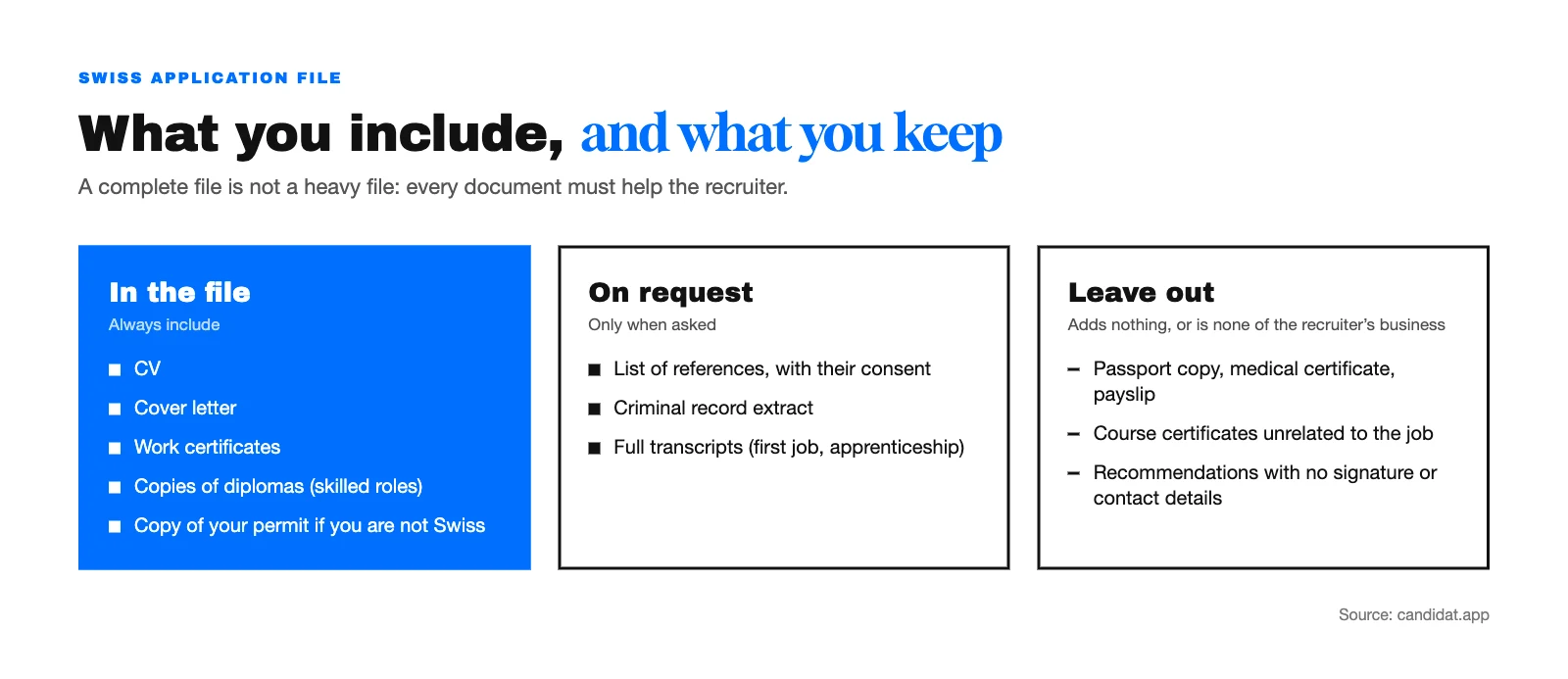
A Swiss application file does not need personal documents or documents unrelated to the job. A passport copy, a medical certificate, a payslip, full school reports and half-day course certificates make the file heavier without helping the recruiter. A file that is too thick dilutes what matters most, namely the CV and the certificates.
- Half-day course certificates unrelated to the job. Keep them for the CV, on one line, if they are relevant.
- Full school reports, except for a first job or an apprenticeship when the ad asks for them.
- Personal documents: passport copy, medical certificate, payslip. The Federal Data Protection and Information Commissioner points out that the questions allowed during recruitment are those concerning the applicant's qualifications.
- Generic reference letters with no signature or contact details. They add nothing verifiable.
The documents you send belong to you. According to the Federal Data Protection and Information Commissioner, the documents of a rejected applicant must be returned to them, and copies in principle destroyed, unless the applicant agrees to their storage for a defined period.
How do you prepare a reusable application file?
A reusable application file separates the fixed documents from the documents to adapt. Work certificates, diplomas and the permit copy are scanned once and stored in a folder. The CV and cover letter, on the other hand, change with each job ad, because they are what the recruiter compares with the other applicants.
The first preparation takes the longest: gathering, scanning and naming each certificate. After that, each application only requires the work that makes the difference. A file sent unchanged to twenty employers is easy to spot. Adapting the CV to the wording of the ad and writing a letter about that specific company is where everything is decided.
That is exactly what candidat.app does: starting from your real background, the tool prepares a CV and a cover letter tailored to each job posting, following Swiss conventions and readable by screening software, without inventing anything about your profile. All you have to do is attach your certificates and diplomas, which stay the same.
In summary
A Swiss application file brings together a cover letter, a CV, work certificates and copies of diplomas, plus a copy of the permit if needed and a criminal record extract when the ad asks for it. It is assembled in that order, as a single well-named PDF for an email application, or document by document on an online portal. Work certificates are a Swiss particularity: every employer must provide one on request, and recruiters read them. References are given on request, and the employer needs your consent to call them. The CV remains the document that decides, so it is the one to adapt to each job posting.
FAQ
What is a complete application file in Switzerland?
A complete application file in Switzerland brings together the cover letter, the CV, work certificates and copies of diplomas. Foreign applicants add a copy of their residence permit, and the criminal record extract only if the ad requires it.
In what order should the documents of a Swiss application file go?
The usual order is: cover letter, CV, work certificates from most recent to oldest, diplomas, then administrative documents such as the permit.
Should I send my application file as a single PDF?
By email, yes: a single PDF named with your name and the role is the most practical for the recruiter. On an online portal with one field per document, follow the requested split.
I have never worked in Switzerland and have no work certificate: is that a problem?
No. Swiss recruiters know that the work certificate is a practice specific to Switzerland. A reference letter or a proof of employment can replace it, with no obligation.
Can a Swiss employer call my former employers without telling me?
No. According to the Federal Data Protection and Information Commissioner, the employer must obtain your consent before contacting your current employer or a former one.
