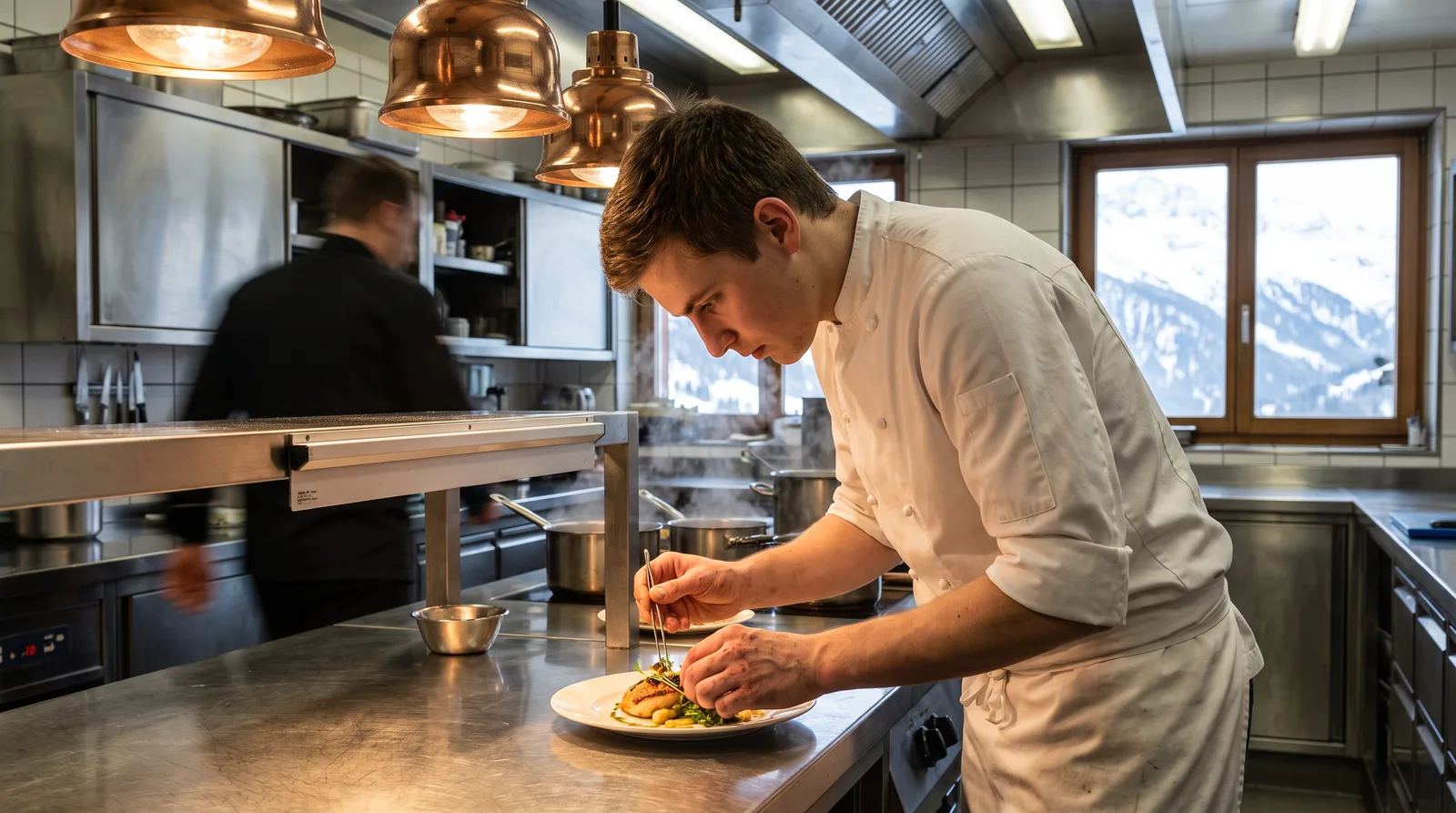
A hospitality CV in Switzerland fits on one to two pages and highlights the diploma, the establishments, the positions held and the dates of availability. Seasons are grouped by establishment or by region. According to GastroSuisse, the 2026 minimum wage in the sector depends on the diploma: from 3,713 to 5,293 francs a month.
"I am a cook, I have done six seasons in four years. The recruiter will think I cannot hold down a job." This is the most common fear among hospitality professionals applying in Switzerland. The fear is understandable, but often misplaced.
In a sector that partly follows the calendar of ski resorts and lakeside towns, a run of short contracts is normal. What worries an employer is a CV that does not make the career path clear. This article shows how to present your seasons, what a head chef or hotel manager looks for first, and what your diploma changes to your pay.
How do Swiss recruiters assess the stability of a seasonal cook?
A Swiss hospitality recruiter does not penalise a cook who works season after season. The recruiter assesses stability through three signals: seasons completed, returns to the same employer, and progression in roles. Stability is therefore judged on the consistency of the career path, not on the length of each contract.
- Do you finish your seasons? A seasonal contract broken off after three weeks gets noticed. A run of completed seasons reassures.
- Do employers take you back? Returning to the same establishment several seasons in a row is the strongest signal a seasonal worker can give: an employer chose them twice.
- Are you progressing? Moving from commis to demi chef de partie, then to chef de partie, shows that you are trusted with more.
Your CV must make these three answers visible within seconds.
How do you present seasonal work on a CV in Switzerland?
Seasonal work is presented on a Swiss CV by grouping it, by establishment when you returned to the same place several times, or by type of season and region when you changed establishments. Listing each season as a separate job, with ten lines of dates, makes the CV unreadable and creates exactly the impression of instability you want to avoid.
Option 1: group by establishment. If you went back to the same place several times, make it a single entry.
Chef de partie, garde-manger · 4-star hotel, Verbier (Valais) 4 winter seasons, December 2022 to April 2026 · In charge of the cold station for a 120-cover restaurant · Trained two commis chefs each season · Rehired every season, promoted to chef de partie in 2024
Option 2: group by type of season. If you changed establishments, an entry such as "Summer seasons, Lake Geneva region, 2021 to 2025", followed by the establishments on one line each, keeps the CV readable.
Option 3: list year-round jobs separately. A permanent job is presented in the usual way, with its start and end dates.
The gaps between seasons need no explanation on the CV. If you did something else during those periods (training, cover work, travel, another sector), one line is enough. At interview, the answer is simple: that is how the trade works.
These examples are illustrations. Adapt the figures to what you actually did, without rounding them up.
What structure should a hospitality CV follow in Switzerland?
A hospitality CV in Switzerland follows the classic order of the Swiss CV: header with target title and permit, experience, education, skills, languages. Two blocks matter more than in other trades: the languages you speak, essential in the dining room and at reception, and your dates of availability, because a seasonal establishment recruits for precise dates.
| Block | What it contains | What the recruiter checks |
|---|---|---|
| Header and title | Name, phone, email, town, work permit, target title ("Cook, federal certificate of vocational education and training (CFC)", "Station waiter") | Your trade and your administrative status at a glance |
| Experience | Positions, establishments, type of cuisine or service, number of covers or rooms if you know it | The level of the establishment and your role |
| Education | CFC, federal attestation of vocational education and training (AFP), federal professional certificate, hotel school, courses taken | Your pay category and technical level |
| Skills | Stations mastered (hot, cold, pastry), hygiene standards, till or booking software | That you are operational without a long settling-in period |
| Languages | Levels A1 to C2 of the European framework | Essential in the dining room and at reception |
| Availability | Possible season dates, staff housing needed or not | That you fit the establishment's calendar |
The CFC and the AFP are the Swiss apprenticeship diplomas. According to the State Secretariat for Education, Research and Innovation (SERI), the CFC certifies a three- or four-year programme, the AFP a two-year programme.
In the dining room, at the bar or at reception, speaking German, English or Italian in addition to French clearly widens your choice of establishments, especially in resorts. State your languages using the European framework, as explained in our article on language level on a CV. For availability, "Available from 1 December to 20 April" is better than "available at short notice".
For length, our guide to the number of pages of a CV in Switzerland gives the rule. For most profiles in the sector, one well-built page is enough.
What minimum wage does your diploma give you in Swiss hospitality?
In Swiss hospitality, the minimum wage depends on the diploma. The national collective labour agreement for the hotel and restaurant sector (CCNT) classifies employees into categories according to their training. According to the 2026 notice from GastroSuisse, the sector's employers' association, the gross monthly minimum ranges from 3,713 francs without training to 5,293 francs with a federal professional certificate.
Here are the 2026 gross monthly minimums in ordinary establishments, according to the 2026 CCNT wage calculation notice published by GastroSuisse:
| CCNT category | Profile | Gross monthly minimum 2026 |
|---|---|---|
| Ia | No vocational training | 3,713 francs |
| Ib | No training, with the Progresso course | 3,943 francs |
| II | Federal attestation (AFP) | 4,070 francs |
| IIIa | Federal certificate (CFC) | 4,528 francs |
| IIIb | CFC with additional training | 4,635 francs |
| IV | Professional examination (federal professional certificate) | 5,293 francs |
According to the same notice, these amounts apply to a 42-hour week in ordinary establishments and a 43.5-hour week in seasonal businesses, and the CCNT provides for a 13th monthly salary. Some cantons, such as Geneva, have a cantonal minimum wage that can exceed the agreement's minimums for the lowest categories. Our article on the 13th salary in Switzerland explains the 13th month.
Your diploma must therefore be written clearly on your CV, since it partly determines your category. If your diploma was obtained abroad, write its original title and length, without presenting it as a CFC. Equivalence is discussed with the employer, on a clear basis.
Which certificates and which permit do you need for a season in Switzerland?
For a season in Switzerland, two documents reassure the recruiter: the work certificates from previous seasons and a clear permit status in the CV header. The work certificate, issued by the employer on request, describes your duties and assesses your work. The permit depends on your nationality and on the length of the contract.
In Switzerland, the employer must issue a work certificate at any time, on simple request: this is article 330a of the Swiss Code of Obligations, as the canton of Geneva points out. In a seasonal trade, ask for it at the end of every season. Recruiters in the sector read these certificates, and a series of positive certificates is worth more than any sentence about your reliability. Our article on the Swiss work certificate helps you read them and request them.
For a citizen of the European Union or of the European Free Trade Association (EFTA: Iceland, Liechtenstein, Norway), the State Secretariat for Migration (SEM), the Swiss federal immigration office, provides for two cases for short contracts:
| Length of contract | What you need | Who handles it |
|---|---|---|
| Up to three months (90 days) per calendar year | No permit, a simple online notification | The Swiss employer |
| From three months to one year | The L permit, the short-term residence permit | Application to the canton |
For someone who is not a citizen of a European country, the rules are much stricter, and hiring for a seasonal job is rare. Our article on Swiss work permits details each category.
What should a cover letter for a hospitality job in Switzerland say?
A cover letter for a hospitality job in Switzerland fits in a few sentences and answers three questions: why this establishment, for which dates, and what you bring from the first service. A head chef or accommodation manager skims the letter, so three precise sentences are worth more than a page about your "passion for gastronomy".
Mention the establishment's type of cuisine or clientele, your exact availability and one concrete achievement. If you need staff housing, say so: many resort establishments expect this information.
Tailoring your CV to each establishment takes time, especially when applying for several seasons at once. candidat.app starts from your real background to generate a CV and a cover letter tailored to each job ad, to Swiss conventions, with your seasons grouped and readable. Nothing about your profile is invented: your establishments, positions and diplomas remain your own.
In summary
A hospitality CV in Switzerland must make your career path clear within seconds. Group your seasons by establishment or by type rather than stacking them, and show when an employer took you back or promoted you. Highlight your diploma, the stations you master, your languages and your dates of availability. Your diploma also matters for your pay: according to GastroSuisse, the CCNT sets 2026 minimums from 3,713 francs without training to 5,293 francs with a federal professional certificate, plus a 13th month. Ask for a work certificate at the end of every season and state your permit clearly.
FAQ
How do Swiss recruiters assess the stability of a cook who works seasons?
Swiss hospitality recruiters look at whether the cook finishes their seasons, returns to the same employers and progresses in their roles. Working season after season is not frowned upon in the sector. A CV that groups seasons makes this career path readable.
What is the minimum wage for a cook with a CFC in Switzerland?
According to the 2026 CCNT notice from GastroSuisse, a holder of the federal certificate of vocational education and training (CFC, category IIIa) is entitled to at least 4,528 francs gross a month in an ordinary establishment, plus a 13th month. Some cantons set a higher minimum wage for the lowest categories.
Do you need a permit for a season in Switzerland?
For a European Union citizen, a contract of less than three months goes through a simple notification by the employer, within a limit of 90 days per calendar year, according to the State Secretariat for Migration. Beyond that and up to one year, a short-term L permit is required.
Should I ask for a work certificate after every season?
Yes. Article 330a of the Swiss Code of Obligations lets you request a work certificate at any time. A series of positive certificates is one of the best proofs of reliability in hospitality.
What should a cover letter for a hotel job in Geneva include?
A cover letter for a hotel in Geneva stays short: why this establishment, your dates of availability, one concrete achievement and the languages you speak. Three to five precise sentences are enough in the sector.
